
Navigating government contracts for IT consulting can be overwhelming. From sifting through thousands of bids to ensuring compliance with strict regulations, the process is both time-consuming and high-stakes. Specialized AI tools can help.
Top 5 AI-Powered RFP Tools for IT Consulting Firms
Here’s a quick look at the top tools:
- Narwin.ai: Excels in automated bid discovery, compliance checks, and tailored proposal drafts.
- DeepRFP: Focuses on fast proposal creation with tools like compliance matrices and AI-powered analysis.
- Loopio: Offers a robust content library and integrations for managing RFP responses efficiently.
- Arphie: Integrates directly with your data sources for accurate compliance tracking and proposal creation.
- AutogenAI: Specializes in federal and DoD contracts with precise requirement extraction and custom language engines.
Quick Comparison
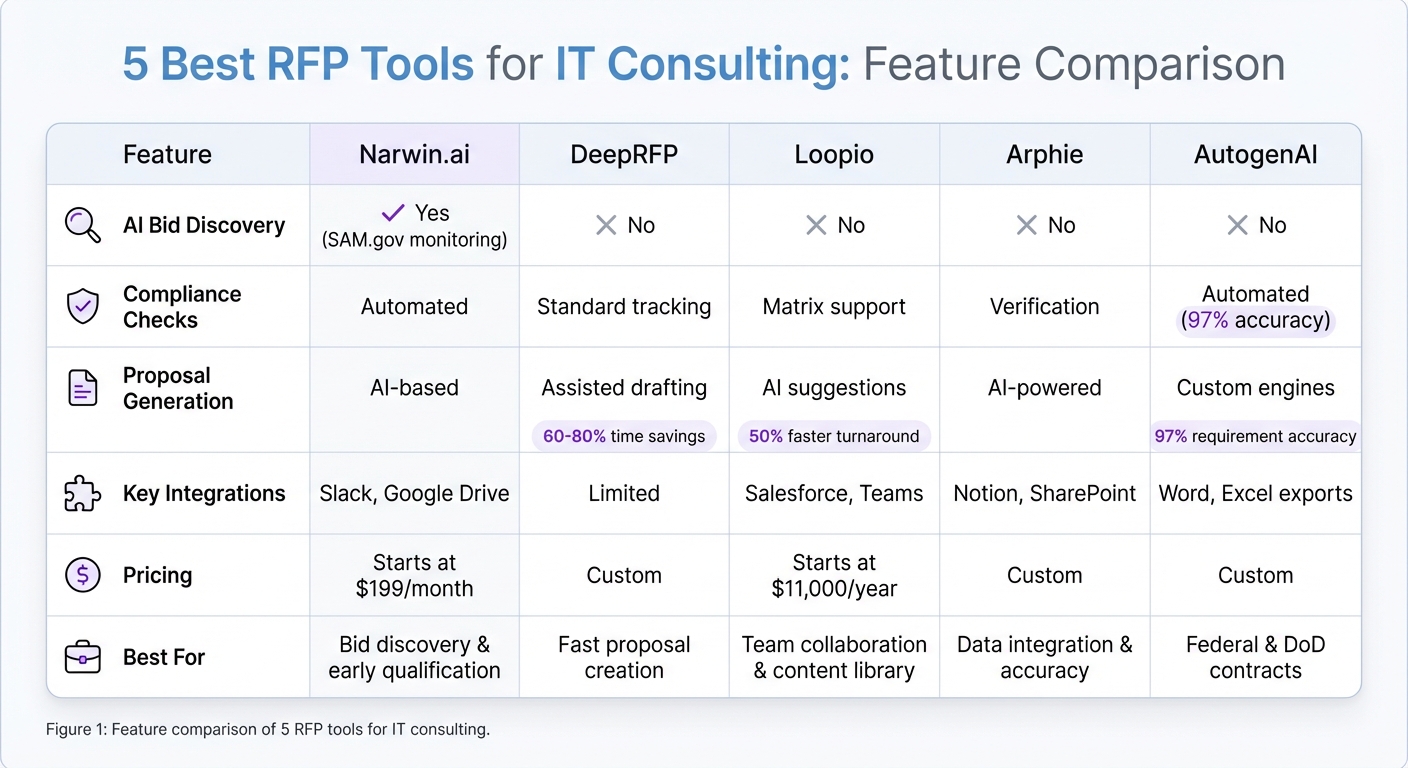
| Feature | Narwin.ai | DeepRFP | Loopio | Arphie | AutogenAI |
|---|---|---|---|---|---|
| AI Bid Discovery | Yes | No | No | No | No |
| Compliance Checks | Automated | Standard tracking | Matrix support | Verification | Automated |
| Proposal Generation | AI-based | Assisted drafting | AI suggestions | AI-powered | Custom engines |
| Integrations | Slack, Google Drive | Limited | Salesforce, Teams | Notion, SharePoint | Word, Excel exports |
| Pricing | Starts at $199/month | Custom | Starts at $11,000/year | Custom | Custom |
Each tool addresses different challenges. Narwin.ai is ideal for bid discovery. DeepRFP and AutogenAI focus on compliance and federal contracts. Loopio and Arphie shine with integrations for team workflows. Choose based on your firm’s priorities to save time and optimize your government RFP process.
1. Narwin.ai
Narwin.ai takes a unique approach to proposal management by focusing on early-stage qualification. Instead of just speeding up your response time, it helps you make smarter decisions – evaluating whether an opportunity aligns with your goals based on factors like fit, profitability, and risk. This is especially useful for IT consulting firms, where resources are often limited, and pursuing low-probability bids can be costly. Let’s dive into how Narwin.ai simplifies bid discovery, compliance checks, and successful government bid creation.
Smarter Bid Discovery with AI
Narwin.ai continuously monitors government procurement platforms like SAM.gov and state-level databases, matching opportunities to your profile using plain English searches (e.g., “cybersecurity contracts in Virginia”). Each opportunity is assigned an instant match score, so you can quickly pinpoint RFPs that align with your strengths before committing to a deeper analysis.
Simplified RFP Analysis and Compliance
The platform automatically extracts requirements from RFP documents and performs a detailed buyer analysis to clarify agency expectations. It provides a qualification score that evaluates fit, profitability, and risk, giving you a clear go/no-go decision. For IT consultants working on federal projects, it also flags compliance issues, such as “Protected B” data handling or security screening requirements, helping you address potential gaps in certifications or compliance standards before submission.
Contextual Proposal Drafting
Using Retrieval-Augmented Generation (RAG), Narwin.ai pulls from your past proposals, technical documents, and online content to create tailored drafts. Unlike generic templates, these drafts are rooted in your actual experience, ensuring more relevant and impactful proposals. In side-by-side comparisons with older tools, Narwin.ai is rated “Strong” for both requirement extraction and bid scoring.
Seamless Integrations for Collaboration
Narwin.ai connects with Slack and Notion, making it easy for teams to collaborate without juggling multiple platforms. These integrations streamline access to AI-generated drafts and qualification reports, supporting efficient internal workflows. Designed with lean teams and startups in mind, the platform is perfect for those adopting AI-first processes, even if they lack a dedicated proposal team.
2. DeepRFP
DeepRFP is an AI-driven proposal platform tailored specifically for government bids. Launched in late 2021, it stands apart from traditional tools by being purpose-built to handle every stage of the proposal process with specialized AI agents. For IT consulting firms juggling multiple federal RFPs, this means quicker turnarounds without compromising quality. Here’s a closer look at its standout features.
AI-Powered Bid Discovery
The RFP Analyzer Agent simplifies bid/no-bid decisions, completing analyses in just minutes. It flags potential risks and offers clear, actionable recommendations. Richard, a Chief Commercial Officer, shared his experience:
“I first tried DeepRFP Pro on a short turnaround 24-page RFI and it paid for itself right away. The response was on-point and cogent and impressed my colleagues”.
RFP Analysis and Compliance Checks
DeepRFP’s RFP Shredding Software transforms tender documents into structured Excel spreadsheets, automatically identifying key requirements and potential red flags. Additionally, the Compliance Matrix Generator extracts every “shall” or “must” into an XLSX matrix, ensuring nothing is overlooked. For IT firms working on government contracts, this automation replaces hours of manual compliance tracking. For example, drafting a 60-page government bid with DeepRFP takes about 15 minutes, with finalization in 2 hours – compared to the 20+ hours it typically takes manually.
Proposal Generation and Customization
Using a Company Library and virtual subject matter experts (SMEs), DeepRFP creates proposals that reflect your firm’s expertise, even for intricate IT requirements. Kari, a Proposal Writer, highlighted its impact:
“With this platform, I have accelerated my proposal writing timelines while maintaining a high level of quality and professionalism – truly a game-changing asset in the fast-paced world of proposals”.
Clients report saving between 50% and 80% of the time they usually spend on proposal tasks.
Seamless Integrations for IT Workflows
DeepRFP integrates smoothly with existing tools, offering 1-click exports to Word and Excel for easy collaboration. It is SOC 2-compliant, hosted on U.S. servers, and ensures customer data is never used for AI training. Pricing starts at $75 per user per month with monthly billing. A 7-day free trial is available, and it supports proposal generation in 28 languages through an English interface.
3. Loopio
Loopio is a proposal management platform designed with a focus on compliance and precision. It relies on a vetted content library, ensuring that every response meets regulatory standards and reflects your organization’s approved expertise. With a 4.7/5 rating on G2 and over a decade of experience drawn from more than 500,000 projects, Loopio has built a strong foundation for managing RFPs with modern strategies.
RFP Analysis and Compliance Checks
Loopio’s Intelligent Import feature simplifies the tedious task of identifying key requirements like “shall” and “must” from government documents in Excel, Word, and PDF formats. Its Confidence Pulse tool provides real-time accuracy scores for answers, while inline citations link directly to original source documents, creating a clear audit trail. This level of traceability ensures compliance at every step. According to Kerry Colvett, VP of Sales Enablement, users have seen a 50% reduction in overall RFP turnaround time and a 90% improvement for specific questionnaires.
Proposal Generation and Customization
Loopio’s Magic Auto-Fill tool automates up to 60% of initial RFP responses by leveraging pre-approved content from past projects. Leah McTiernan, Vice President of Solution Engineering at DocuSign, shared that her team completed a complex security questionnaire in under 30 minutes using Magic – a task that previously required much more time. For more nuanced questions, the Generate Answers feature creates tailored responses by analyzing your internal content library. Additionally, the Recommend Experts tool uses historical data to identify the best subject matter experts for technical queries. Julie McCoy, Senior Director of Proposal Management at DocuSign, highlighted a 200% increase in RFP efficiency and support for over 130 internal users after adopting Loopio. These tools collectively streamline the proposal process, saving time and boosting productivity.
Integrations for IT Workflow
Loopio integrates seamlessly with platforms like Salesforce and HubSpot, allowing teams to kick off proposals directly from their CRM systems. It also connects with over 80 sources, including SharePoint, Google Drive, and Zendesk, to centralize technical documentation. Collaboration tools like Slack, Microsoft Teams, and Microsoft Copilot 365 further enhance team productivity. With a 415% ROI and a payback period of less than six months, Loopio users complete 25% more RFPs on average. Pricing is tailored to team size, with tiers ranging from Essentials to Enterprise, and annual subscriptions typically starting at $11,000. These features make Loopio a valuable tool for IT consulting firms looking to optimize their government procurement workflows.
4. Arphie
Arphie takes proposal creation to a new level by combining live data integration with patented features, ensuring highly accurate results. Designed specifically for IT consulting teams, this AI-powered platform simplifies the complexities of RFP searches and proposal development. Unlike older tools that rely on constant template updates, Arphie connects directly to your existing data sources – like SharePoint, Google Drive, Confluence, and Notion – making the process much smoother. It’s also SOC 2 Type 2 compliant and includes Zero Data Retention (ZDR) agreements, which means your sensitive government project data stays private and isn’t used to train public AI models.
RFP Analysis and Compliance Checks
Arphie’s AI agents are built to handle RFP requirements with precision. They automatically create compliance matrices, giving teams a clear roadmap for meeting requirements. Transparency is a key feature here: the platform shows the internal sources used for each AI-generated answer, along with confidence scores. Teams can even audit responses step-by-step using logic diagramming tools. Jake Hofwegen, VP of Global RevOps & Enablement, shared:
“With our previous software, people didn’t trust it. With Arphie, we can generate answers we trust and verify, straight from our own sources”.
Proposal Generation and Customization
Arphie’s AI agents pull from your firm’s historical data to ensure compliance with government standards. The platform also allows you to tailor the AI’s writing style to match your team’s brand voice while maintaining technical accuracy. One standout feature is Smart Merge, which automatically eliminates duplicate Q&A library entries – critical for managing large volumes of documentation. Users have reported workflow improvements of 60–80%. Rachael McDaniel, Senior Manager of Global Proposals, praised the platform, saying:
“Arphie has lifted this burden and created this sense of delight… people stop me in the hall and say, ‘I tried Arphie – it’s incredible’”.
Beyond these capabilities, Arphie integrates seamlessly with widely-used collaboration tools to further enhance productivity.
Integrations for IT Workflow
Arphie connects in real time with platforms like Google Drive, SharePoint, Confluence, Notion, Seismic, Highspot, and even specific URLs. This eliminates the hassle of manually updating content libraries while complementing the platform’s automation features. It also supports SSO via SAML 2.0 and offers role-based permissions to meet enterprise security needs. Collaboration tools enable teams to assign RFP questions to specific members, track progress, and send automated reminders. Migrating from older RFP software is quick, typically taking less than a week, and Arphie’s white-glove onboarding ensures no historical knowledge base is lost. Greg Kieran, Director of Solutions Engineering, highlighted:
“We wanted a tool that was truly simple and easy. Arphie fit exactly that, and nobody on our team has ever said they couldn’t figure it out”.
5. AutogenAI
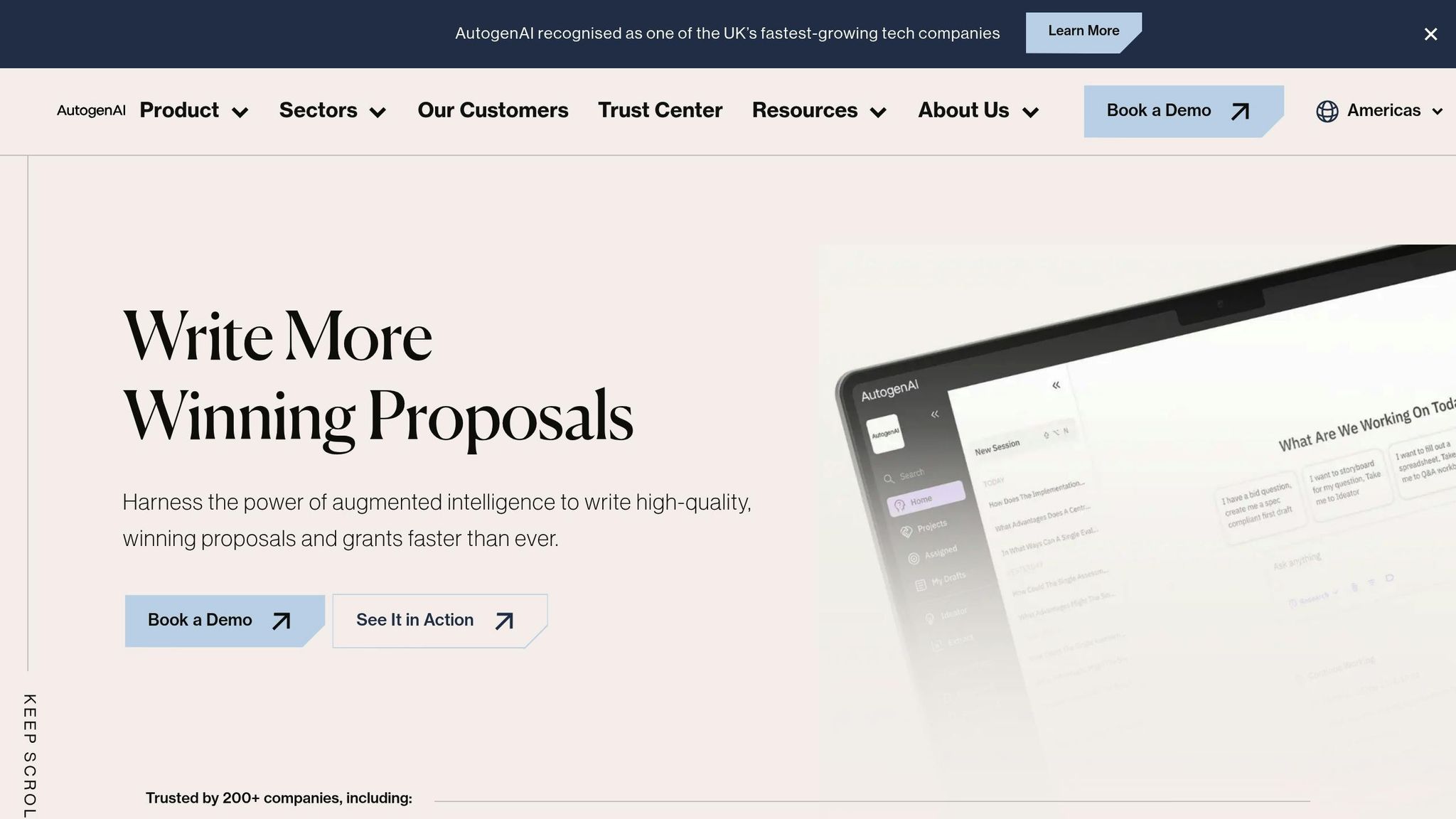
AutogenAI simplifies the entire proposal process, from initial discovery to final submission. Designed after more than 100,000 hours of development by a specialized federal team, it ensures secure and compliant responses to RFPs. The platform has been recognized with three G2 awards: Best ROI, Fastest Implementation, and Best Support. One of its standout capabilities is its precise analysis of RFP documents.
RFP Analysis and Compliance Checks
At the core of AutogenAI’s functionality is the Extract tool. This tool scans federal, DoD, state, and municipal solicitations to pinpoint requirements, sections, CLINs, deliverables, and evaluation factors. It identifies 97% of requirements with full context and achieves 89% accuracy in generating proposal drafts. It also flags critical “shall”, “must”, and “will” statements, ensuring no mandatory requirements are missed during compliance reviews. Additionally, the tool is trained to navigate key government contracting sections, including Section C (performance requirements), Section L (instructions), and Section M (evaluation criteria). Mark Sargeant, Head of Business Development at Twin Training, highlighted its impact:
“AutogenAI, not only elevated the quality of our bids, but it also increased the speed of responses, especially when faced with challenging questions.”
Teams using the RFP Extract feature have reported saving 60% of the time typically spent on proposals, along with a 78% faster turnaround for proposal development. The tool’s integrated OCR engine ensures accurate data extraction from PDF solicitations.
Proposal Generation and Customization
AutogenAI goes beyond analysis to excel in proposal creation. The platform builds custom language engines tailored to reflect your company’s tone and technical style, pulling and adapting content from your existing library. Haydn Scarborough, Managing Director at Sketch Consulting, noted that the platform makes it possible to complete 80% of bid work with remarkable speed. Similarly, Glenn Marshall, CEO of AMS Group, emphasized the platform’s role in preserving institutional knowledge:
“AutogenAI has significantly safeguarded our internal IP by ensuring we have an accessible repository of our technical solutions created over the past two decades.”
The platform also features a Research Assistant, which uses AI to gather and analyze information from both internal knowledge libraries and online sources to inform bid strategies. With one-click exports to Word, Excel, PDF, and CSV formats, the tool streamlines bid preparation and allows for easy refinements. By merging advanced analysis with efficient content generation, AutogenAI strengthens IT consulting proposals and accelerates the process from start to finish.
Detailed Comparison Table
Choosing the right RFP tool for your IT consulting firm depends on your specific needs, whether it’s bid discovery, compliance checks, or proposal generation. Below is a side-by-side comparison of five platforms, focusing on features that are crucial for securing government contracts.
| Feature | Narwin.ai | DeepRFP | Loopio | Arphie | AutogenAI |
|---|---|---|---|---|---|
| AI Bid Discovery | Tracks SAM.gov, CanadaBuys, and procurement portals with daily AI-matched opportunities | No automated bid discovery | No automated bid discovery | No automated bid discovery | No automated bid discovery |
| RFP Analysis | Automated requirement extraction, compliance checks, and risk identification | AI-powered analysis with requirement extraction | Manual content management with AI assistance | AI-driven requirement parsing | Extract tool identifies 97% of requirements with full context |
| Win Probability Scoring | Proprietary AI win score based on compliance, buyer behavior, and historical data | Not available | Not available | Not available | Not available |
| Compliance Checks | Automated gap identification and risk detection | Standard compliance tracking | Compliance matrix support | Compliance verification | Flags key compliance terms automatically |
| Proposal Generation | Unlimited AI proposal writing with company-trained RAG models | Assisted proposal drafting | Content library with AI suggestions | AI-powered proposal drafting | Custom language engines for drafting proposals |
| Integrations | Google Drive, Slack | Limited integrations | Google Drive, Slack, Microsoft Teams, SharePoint, browser extension | Google Drive, Slack, Microsoft Teams, SharePoint, Notion | One-click exports to Word, Excel, PDF, CSV |
| Pricing | Free plan available; Starter at $199/month; Growth at $599/month; Custom enterprise | Custom pricing | Custom pricing | Custom pricing | Custom pricing |
| IT-Specific Government Features | Federal, state, and municipal tender coverage with instant go/no-go signals | General RFP support | Industry-agnostic content management | Cross-industry proposal support | Designed for federal and DoD contracts |
This table provides a clear breakdown of each platform’s strengths. Narwin.ai stands out with its automated bid discovery and in-depth RFP analysis, making it ideal for IT consulting firms targeting government opportunities. AutogenAI shines in its focus on federal and DoD contracts, offering highly accurate requirement extraction. Both Loopio and Arphie excel in their broad integration options, supporting tools like Google Drive, Slack, and Microsoft Teams. DeepRFP, while offering strong analysis capabilities, lacks proactive bid discovery features. By matching the tool’s features to your firm’s priorities, you can streamline how AI is transforming the RFP process for both bid tracking and proposal creation.
Conclusion
AI-powered tools are revolutionizing the way teams handle RFPs by simplifying discovery, streamlining analysis, and ensuring compliant proposal drafting. These tools can cut proposal cycles in half and lower costs by 20–25%, enabling teams to double the number of RFP responses they can manage.
When choosing a tool, focus on solving your firm’s most pressing challenge. For automated bid discovery, look for platforms that monitor sites like SAM.gov and CanadaBuys daily, matching opportunities to your profile. If compliance is your priority, opt for tools that can identify “shall/must/will” requirements with 97% accuracy and seamlessly map Section L to Section M. For agencies handling sensitive government data, ensure the platform adheres to FedRAMP or NIST 800-171 standards.
The impact of AI on government procurement is undeniable. By 2025, 74% of procurement leaders expect AI to bring transformative changes. In fact, some firms have already seen a 67% increase in proposals and a 93% RFP “go-forward” rate, with response times reduced to just 30 seconds.
To make the most of these advancements, focus on addressing your firm’s specific bottlenecks. Whether you need help identifying high-fit opportunities or creating compliant responses, start by testing a free trial or pilot project. Compare the AI-generated compliance matrix with your manual version to evaluate accuracy. Make sure the tool includes sentence-level citations to ensure technical precision.
FAQs
What features should IT consulting firms look for in an RFP tool?
When choosing an RFP tool for IT consulting, it’s important to prioritize features that streamline your workflow and improve accuracy. Tools with advanced search functions can help you quickly find the most relevant opportunities, while AI-driven automation can handle tasks like drafting proposals, checking for compliance, and analyzing risks. These capabilities not only save time but also cut down on manual work.
It’s also worth selecting a tool that integrates easily with your current systems and promotes team collaboration. This ensures your responses are aligned and meet all requirements. Additional features, like customizable notifications for new opportunities and tools for analyzing market data, can help you make informed decisions and maintain a competitive edge in government procurement.
How can AI-powered tools streamline the RFP process for IT consulting firms?
AI-powered tools are transforming the RFP process by taking over tedious tasks and boosting accuracy. These tools can swiftly analyze government solicitations, pull out essential requirements, and create tailored draft proposals. The result? Teams save valuable time and cut down on manual work. Plus, they help ensure proposals meet government regulations by flagging critical sections like FAR requirements, Statements of Work, and evaluation criteria.
With the help of natural language processing and advanced data analysis, these tools let teams focus on crafting strong, persuasive content instead of drowning in administrative tasks. They also make collaboration easier by enabling real-time edits and task assignments, speeding up the entire proposal development process. For IT consulting firms, this means a better shot at winning government contracts with high-quality, compliant proposals – all while working smarter, not harder.
Why is compliance checking important when analyzing government RFPs?
Compliance checking plays a critical role when reviewing government RFPs. It ensures your proposal aligns with all outlined requirements and adheres to necessary regulations. Without meeting these standards, even the most compelling proposal can be dismissed, leading to wasted time and effort.
By catching gaps or inconsistencies early, compliance checks significantly lower the risk of rejection while improving the quality of your submission. In the competitive world of government procurement, full compliance isn’t just about avoiding disqualification – it can also be a deciding factor in securing contracts, as it often carries significant weight in evaluations.