
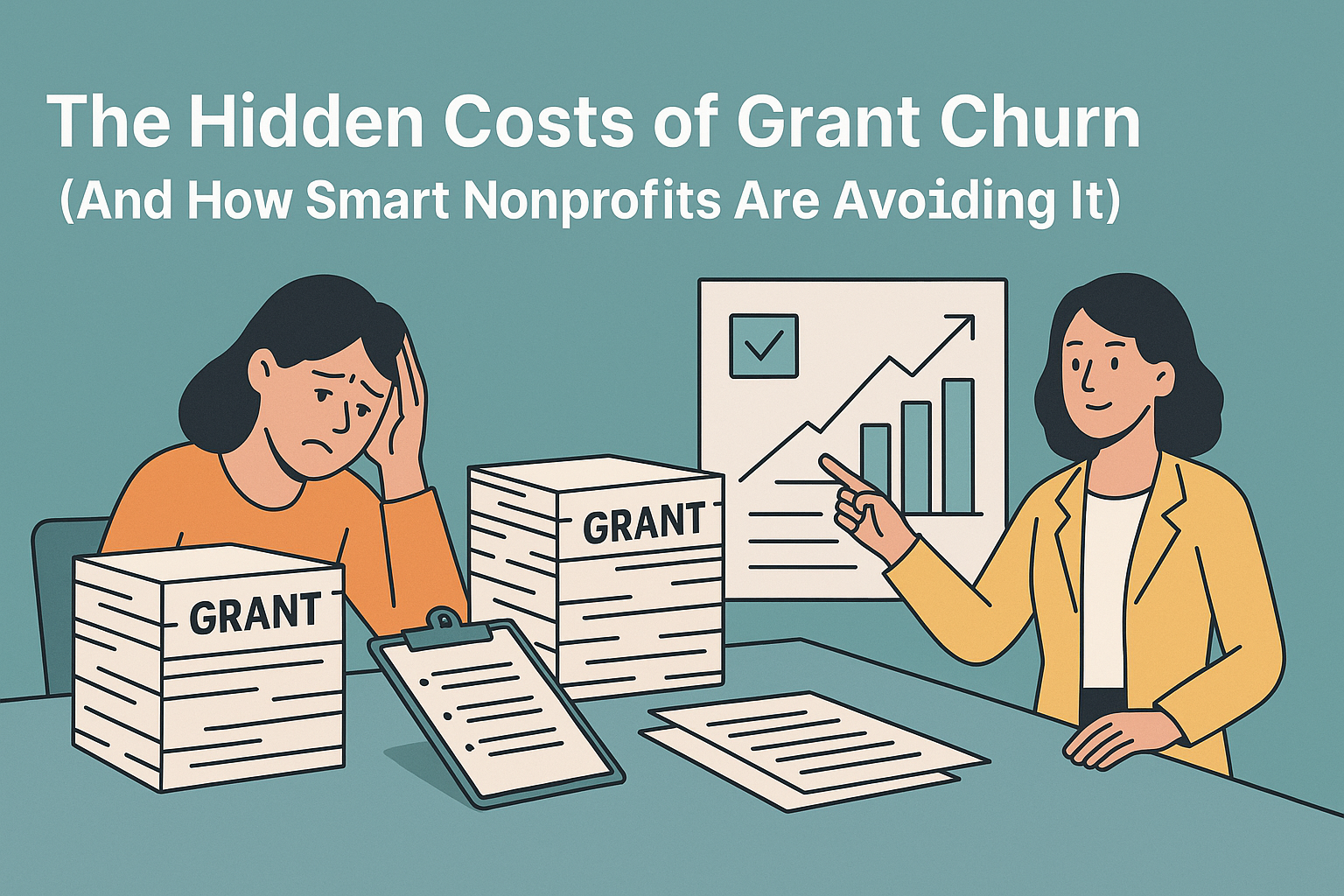
Many nonprofits are stuck in a cycle of grant churn—applying to every opportunity without a clear strategy. This blog explores the hidden costs of that approach and how smart organizations are breaking free with better tools, sharper focus, and a more intentional grant process. Discover how to protect your team’s time, energy, and mission.
Introduction: The Cycle That Drains More Than It Delivers
For many small to mid-sized nonprofits, securing grant funding feels like an endless treadmill—apply, wait, repeat. With pressure to fund programs, meet operational goals, and satisfy board expectations, it’s easy to fall into the trap of grant churn: applying to as many opportunities as possible, regardless of fit, to keep the pipeline active.
But while this approach may seem proactive, it often leads to burnout, low success rates, and a quietly mounting opportunity cost. What begins as hustle ends in exhaustion.
Smart nonprofits are shifting away from this model. Instead of doing more, they’re learning how to pursue better—with clarity, intention, and strategic tools that lighten the load, offering a hopeful relief from the grant churn.

What Is Grant Churn?
Grant churn refers to the cycle of applying to multiple grants too frequently without a filtering process that prioritizes alignment or capacity.
It typically looks like:
- Scrambling to meet deadlines for grants you just heard about
- Writing rushed applications with minimal tailoring
- Reapplying to funders without learning from past outcomes
- Prioritizing submission quantity over submission quality
This churn might keep your calendar full, but it often leads to missed opportunities, inconsistent messaging, and internal fatigue.
The Real Cost of Grant Churn
The danger of churn isn’t just fatigue—it’s what your organization loses while chasing too many low-probability grants:
1. Burnout Among Key Staff
Your team—whether it’s a single executive director or a lean development department—is already stretched. Constantly jumping from one application to another without clear direction can quickly drain morale and momentum.
2. Wasted Hours with Low ROI
Time is one of your most valuable resources. Every application requires program input, budget reviews, and narrative alignment. If 70% of those efforts go toward grants, you’re unlikely to win; that’s strategic time lost.
3. Erosion of Strategic Focus
High-churn grant writing often pushes organizations to shape-shift in order to ‘fit’ funder language. Over time, this can lead to a phenomenon known as ‘mission creep’, where the organization’s activities and focus gradually drift away from its original mission, resulting in inconsistent storytelling or promising deliverables that aren’t truly sustainable.
4. Missed Opportunities Elsewhere
While chasing long-shot grants, you may be ignoring stronger, more aligned funding relationships—or failing to invest in cultivating new ones.


How Smart Nonprofits Are Breaking the Cycle
The most effective nonprofits don’t apply for more grants. They apply to the right ones—and say no to the rest, empowering themselves with the control over their grant applications.
1. They Filter Before They Write
Instead of jumping into drafting mode, innovative teams start by asking:
- Does this funder align with our mission?
- Are we truly eligible?
- Can we deliver on their expectations?
- Do we have a relationship or context?
This triage approach creates a natural “no” filter, protecting the team’s time and focus.
2. They Use Data From Past Applications
Successful teams don’t treat every grant like a one-off. They analyze:
- What language worked?
- Which funders engaged?
- Where were we competitive—and where weren’t we?
This institutional memory—often stored in shared drives or grant management tools—allows them to improve with every submission rather than starting from scratch.
3. They Create Reusable Assets
Strong nonprofits build a “grant-ready” library with:
- Core narrative blocks (mission, history, programs)
- Logic models and outcomes frameworks
- Budget templates and organizational charts
This library doesn’t replace customization—it supports it. The goal is to reduce repetitive lift and focus more energy on aligning with the funder’s specific ask.
4. They Collaborate With Focus
Whether the team is one person or ten, coordination matters. Smart nonprofits align early:
- What materials do we need?
- Who’s responsible for what?
- What’s the realistic timeline?
They avoid last-minute scrambles by assigning roles clearly and building feedback loops early in the process. These feedback loops, which can be in the form of post-application reviews or regular team meetings, allow the team to learn from past experiences and continuously improve their grant application process.
The Role of Smart Tools in Reducing Churn
What sets top nonprofit teams apart isn’t just discipline—it’s support.
Some are turning to AI-assisted tools to streamline the parts of grant writing that are most repetitive or time-consuming without losing control of their voice or strategy. These tools can:
- Break down complex RFPs into precise requirements
- Surface high-alignment opportunities before writing begins
- Help generate tailored draft content from existing organizational data
- Organize materials and versioning in one place
They’re not about cutting corners—they’re about making clarity easier to reach.

Where Narwin Fits In
For nonprofits ready to transition from a reactive to a strategic approach, Narwin offers a new kind of support.
Built with lean nonprofit teams in mind, Narwin helps you:
- Evaluate grant fit before committing precious time
- Break down funder requirements into manageable steps
- Generate tailored proposals from your data
- Track feedback loops and internal knowledge over time
And with nonprofit-friendly pricing, it’s built to empower—not overwhelm.
Narwin won’t write your mission. But it will help you protect it—by giving your team more clarity, more time, and more control over which grants you pursue and how.
👉 Explore Narwin for nonprofits: https://narwin.ai/non-profit/